Chapter 1 – “A Plumber? You’ll Disgrace This Family” – Then His Face Was On Every Channel 3 Days Later
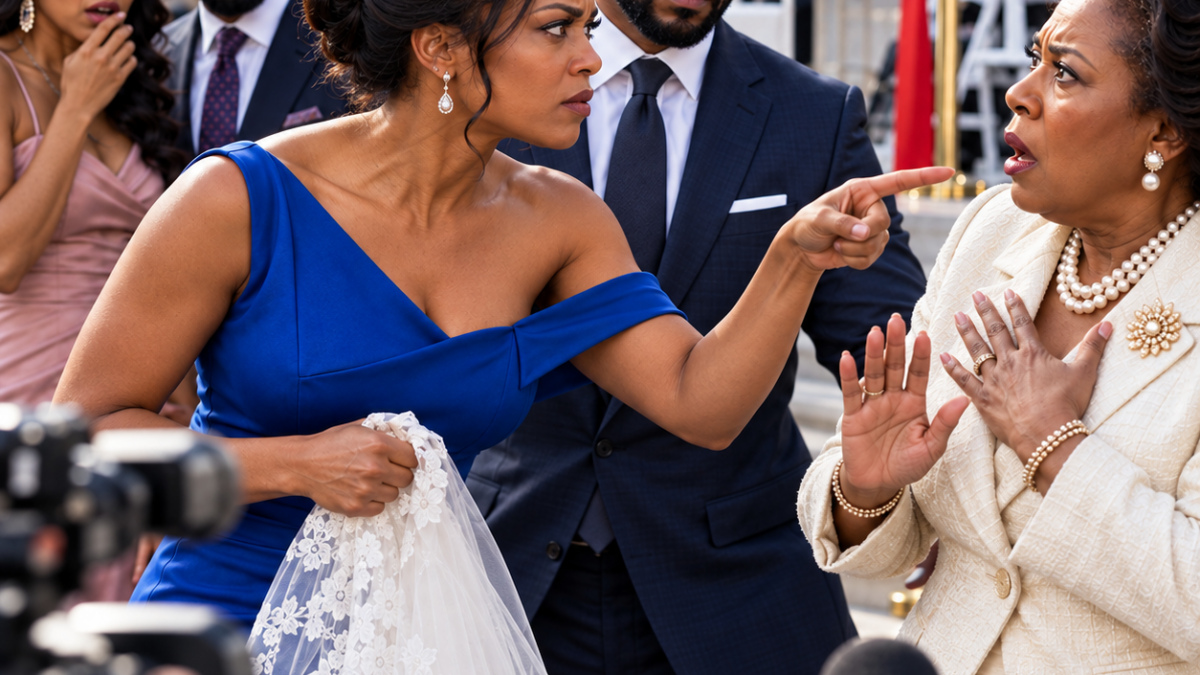
CHAPTER 1 – The Word They Heard
At 34 years old, I learned that my mother could try to bury a marriage before it even had a wedding photo.
I was standing in the kitchen of the Detroit condo I had paid for with 10 years of structural engineering work when I called her.
I told her Andre and I were getting married.
She asked one question.
What does he do?
I said, “He started as a pipe fitter. He owns a water infrastructure company now.”
My mother only heard the first part.
The line went quiet for 4 seconds.
Then Regina Brooks said the sentence that still shows up in my head when a room gets too still.
A plumber.
You will disgrace this entire family.
Then she hung up.
My sister laughed when I called her.
Not a surprised laugh.
A relieved one like she had been waiting for me to give the family something they could use.
Talia.
Camille said, I would rather miss my own funeral than sit in a chapel and watch you do this.
Not one of them came.
My name is Talia Brooks.
I am a black structural engineer from Detroit.
And for most of my life, I thought my family respected foundations.
Then they showed me they only respected the ones they could brag about.
Not my mother, not my father, not Camille, not her husband, Preston, who had spent enough years in commercial construction to know exactly how stupid he sounded when he mocked a man for working with pipe.
I fixed my veil in a tiny back room behind the chapel, smiled at myself in the mirror, and walked toward the altar with one entire side of the room almost empty.
3 days later, Andre’s face was on every channel in Michigan, and my phone had 97 missed calls.
If you have ever watched people ignore your happiness, then sprint toward your life the second it looked useful, stay with me.
Tell me in the comments who only called after the headline because this is not a story about a plumber.
It is a story about what happens when a family that worships status realizes they insulted the man who owned the door they wanted to walk through.
My family is black, polished, proud, and terrified of being looked down on.
Those four things lived together in our house like relatives who did not speak at dinner but still knew where the plates were.
My mother grew up on the east side of Detroit in a brick duplex with a leaning porch and a grandmother who cleaned office buildings at night.
She worked her way into better rooms one careful outfit at a time.
By the time I was in high school, she was Regina Brooks, nonprofit board member, charity brunch chair, woman in pearls, who knew which fork went where and which guest not to invite if the photos mattered.
Then my father left.
Maurice Brooks was a building inspector for Wayne County.
steady, mild, and the kind of handsome that made women at church pass him extra dessert.
When I was 12, he left my mother for a woman named Elise, whose family owned funeral homes, lake property, and a last name my mother pronounced like it had teeth.
People talked.
They did not even have to talk loudly.
Detroit aunties can skin you with a pause.
My mother spent the next 5 years rebuilding herself into someone nobody could pity.
She joined committees.
She bought better table linens.
She changed her hair.
She refused grocery store coupons where people could see her.
She made sure her daughters looked like proof that she had not been abandoned, only upgraded.
My older sister, Camille, understood the assignment.
Camille married Preston Hart at the Detroit Yacht Club in front of 200 people with white orchids, a jazz trio, and a reception so polished it looked sponsored.
Preston owned Hart Commercial Interiors, which meant he wore suits to construction sites and spoke about buildouts in a way that made my mother glow.
He was not a bad contractor.
He was just a man who loved the word contractor more than the work.
Camille became Mrs. Hart with the confidence of someone stepping into a frame built for her.
My mother kept the wedding announcement from the local lifestyle magazine in a silver frame on the living room console.
Talia,” she would say, standing near that photo whenever I visited.
Your sister understood timing.
Timing meant marrying up.
Timing meant no surprises.
Timing meant giving Regina Brooks a son-in-law she could introduce without explaining.
I was the other daughter, the one who measured beams, argued with city inspectors, wore steeltoed boots more often than heels, and cared more about whether a parking structure would hold than whether anyone thought the engineer looked elegant holding the plans.
My mother liked my title, structural engineer sounded clean.
It sounded like degrees and offices and city skylines.
She did not like the mud under my tires, the hard hat in my back seat, or the fact that I had learned to respect people by watching whether they knew what they were doing, not by watching whether they knew how to describe it at a fundraiser.
There is a particular kind of class panic that happens in families like mine.
People outside will sometimes flatten it and say, “They were just snobs.”
That is too simple.
Snobbery was the symptom.
Fear was the illness.
My mother knew what it meant to be underestimated as a black woman walking into polished rooms where people smiled with their mouths and measured with their eyes.
She had been talked over by donors, patted on the arm by women who thought proximity to money made them gentle and treated like help in places where she chaired the committee.
I saw that.
I understood that.
But instead of refusing the measuring stick, she learned to hit us with it first.
She taught Camille to marry the photograph.
She taught me to defend the resume.
She never taught either of us to ask whether a person was good at loving.
That is why Andre confused her.
He did not arrive with the symbols she trusted.
He did not wear achievement like armor.
He drove an old truck when a new one would have made tax sense.
He kept work boots by the back door and read contract language at the kitchen table in a t-shirt.
When city officials called, he stepped onto the porch so he could listen without the dishwasher running.
He had money, but he did not have the kind of ego my mother recognized as money.
So, she decided he had none.
The irony still amazes me.
My mother spent her life fearing people would mistake dignity for poverty.
Then, she mistook dignity for poverty herself.
I met Andre Whitaker at a municipal overpass project near the Rouge River.
That sounds romantic, only if you like concrete, rust, and men arguing over traffic cones.
I was there to inspect load distribution for temporary supports.
His crew was replacing a water mane that ran under the same corridor.
I remember him standing in a trench in a reflective vest, reading a spec sheet with one glove tucked under his arm.
The foreman beside him kept insisting the alignment would work.
Andre looked up at me and said, “If your temporary column shifts half an inch east, my valve vault loses clearance.”
Most people on a job site see a woman engineer and explain things slowly.
Andre asked for my calculation.
That was the first thing I noticed.
The second was that when I answered, he listened, not nodded while waiting to speak.
Listened.
We spent 40 minutes over a folding plan table redrawing an access sequence that saved both teams two days of rework.
At the end, he wiped his hands on a rag and said, “You do not guess much. Neither do you.”
guessing floods basement.
I laughed.
He did not ask for my number that day.
He asked for the revised drawing.
Two weeks later, he emailed me a photo of the valve vault installed with the subject line still dry.
That was how it started.
Andre grew up in Sagena.
His father drove trucks.
His mother worked in a hospital laundry.
He started as a pipe fitters apprentice at 17 because college was not an option and the Bills did not care about potential.
He spent his first years in crawl spaces, basement, municipal trenches, and mechanical rooms so hot the air felt chewed.
By 26, he had three employees.
By 30, he had contracts across Michigan and northern Indiana.
By 37, Whitaker Waterworks had crews in four states.
a union training partnership, emergency response teams, and a reputation for fixing failures other firms had explained around.
He never led with that.
At his house, the thing on the mantle was not an award.
It was an old brass valve coupling, dull and scratched, mounted on a little wood base.
The first time I picked it up, it was heavier than it looked.
What is this?
Andre was making coffee.
First repair I made that held.
That’s all.
That’s enough.
It was from a duplex basement in Sageno.
He was 18.
Three other people had patched the joint.
It kept leaking.
He pulled the whole thing apart, rebuilt the connection, and sat on an overturned bucket for 2 hours, waiting to see if one drop formed.
It did not.
20 years later, he said, setting a mug beside me.
Still holding.
That was how Andre talked about success.
Holding, not winning, not impressing, holding.
I loved him before I knew the full size of his company.
That mattered later.
When Andre proposed, he did it on a Sunday morning while I was barefoot in his kitchen, arguing that he owned too many mismatched mugs.
He did not get down on one knee because he said he would knock over the dog bowl.
He took my hand across the counter and said, “I want my ordinary days with you. All of them, if you will have me.”
I said, “Yes.”
There was no ring yet.
In no audience, no photographer hiding behind a plant.
Just coffee, sunlight, and a man who had never once asked me to shrink my intelligence so he could feel taller.
I called my mother that evening because daughters do hopeful things even after hope has repeatedly embarrassed them.
Mom.
Andre proposed.
Andre.
Yes.
The water man.
His name is Andre.
What does he do exactly?
I took a breath.
He started as a pipe fitter.
He owns a water infrastructure company now.
A plumber.
Mom.
Talia.
Do not mom me.
A plumber.
He owns the company.
You are a structural engineer.
Yes.
You sit on the Arts Foundation Junior Board because you asked me to.
Your sister married a business owner.
So am I.
Do not play word games with me.
There it was.
In my mother’s world, Andre’s ownership did not matter because his origin story had tools in it.
Preston could subcontract drywall crews and be respectable because he wore loafers.
Andre could rebuild municipal water systems and still be reduced to a man with a wrench.
He is kind, I said.
He is smart.
He treats me well.
That is the minimum for some families.
Yes.
She heard the edge.
Her voice dropped.
You will disgrace this entire family.
Then the line went dead.
I stood in my kitchen holding the phone to my ear after she hung up.
The radiator clicked.
Somebody in the alley laughed.
The city kept being the city.
I called Camille.
She answered like she had been waiting.
Mom is beside herself.
Hello to you too.
Talia, what are you doing?
Getting married to a plumber.
To Andre.
You know what people will say?
No.
What will they say?
Do not make me say it.
You already did.
She exhaled through her nose.
I’d rather miss my own funeral than sit there and watch you throw yourself away.
I set my hand flat on the counter.
Have you met him?
No.
Have you asked one question about him?
I know enough.
You know a word.
Sometimes a word is enough.
I hung up on my sister for the first time in my life.
It felt less dramatic than I expected, more like closing a window before smoke came in.
The only person from my side who called with a human voice was Aunt Naen.
Naen is my mother’s older sister, 66, retired nurse, short natural hair, gold hoops, and a porch full of plants she talks to like stubborn patients.
She lives in a small brick house in Ferndale and has never been impressed by my mother’s pearls.
She came over the next Saturday with pound cake wrapped in foil and a look on her face that said, “I was not allowed to lie. Tell me.”
So I did.
All of it.
My mother’s phone call.
Camille’s funeral line.
The word plumber repeated like a stain.
Aunt Naen listened without interrupting.
Then she said, “Your mother has been running from shame so long she started carrying it into rooms herself.”
That was the cleanest sentence anyone had ever said about Regina Brooks.
She told me the parts of the divorce I had been too young to understand.
How my father leaving for a lease had made my mother feel displayed.
How women at church asked questions that sounded soft but had hooks.
How people who had smiled at our family suddenly smiled with pity.
How Regina decided her daughters would become proof that she could not be looked down on.
Camille’s wedding was a metal.
Aunt Naen said she pinned it to her chest and dared people to pity her then.
And me?
You are marrying a man whose work reminds her of the people she thinks looked down on her.
Andre is not those people.
I know that.
She doesn’t.
She has not tried to know.
That was the part I held on to.
Fear, explained my mother.
It did not excuse her.
You Might Also Enjoy

Beyond Espresso: The New Wave of Coffee Innovation

The Renaissance of Physical Libraries in the Digital Age
